
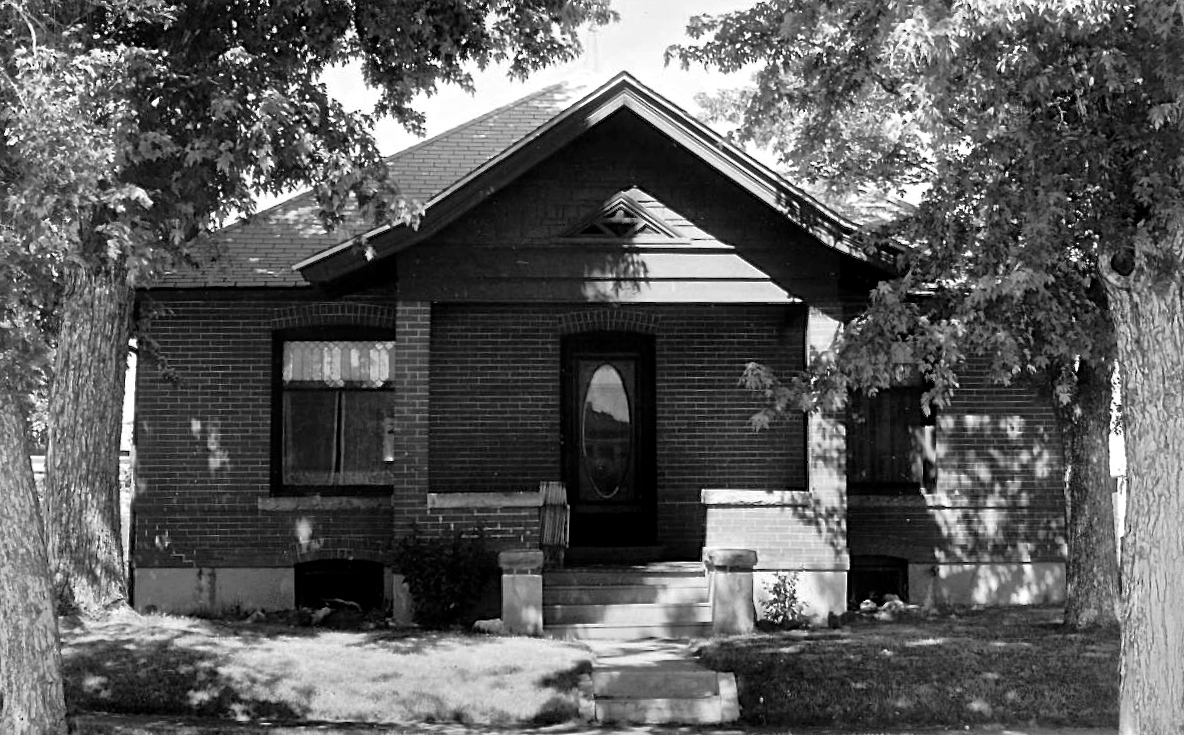
Address:
Quebec House , 1449 Quebec Street
Denver, CO 80220
1906
Bungalow/Craftsman
John J. Burlien
Bowen & Dinsmore Architects
2000
2
Brick
Not Available
Not Available
0

Outdoors
Spring
Not Available
Not Available
Not Available
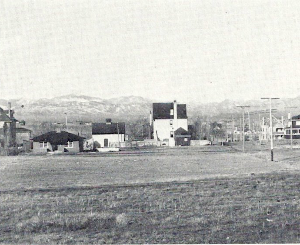
Quebec House is located in the East Denver neighborhood known as Montclair. Here's a photo of the Montclair neighborhood, from the early 1900s. The land was originally barren and had few trees, which provided each home with an amazing view of the front range. I discovered that Montclair was once it's own town and one of Denver's earliest streetcar suburbs. The extensive streetcar network that existed throughout Denver at that time, allowed many people the option to live outside the hustle and bustle of downtown. (Photo is from the Denver Public Library digital photo archives)
Outdoors
Spring
Not Available
Not Available
Not Available
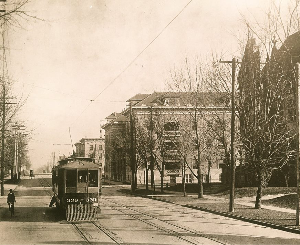
Looking east along Colfax, at Marion Street. In 1907, when John Burlien requested the building permit for 1445 Quebec Street, (Burlien-Dodge House), the main mode of transportation was the streetcar service along East Colfax Avenue (then a residential district). The streetcar ran from downtown denver, all the way out to the city of Fletcher (later known as Aurora). John's office at the W.S. Cheesman Realty Company, was in the 1st National Bank building, downtown (now the Magnolia Hotel). It was the presence of the streetcar, that enabled additional middle class families to move all the way out to the small suburb of Montclair, (about 4.5 miles east of downtown). This may have been a factor in John Burlien's decision to build his home so far out from the city center. (Photo is from the Denver Public Library digital photo archives)
Not Available
Not Available
Not Available
Not Available
Not Available
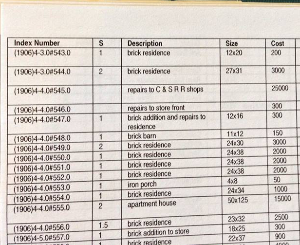
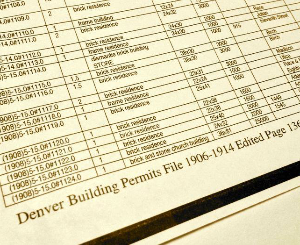
Researching history of home at DPL: Next, I checked a book full of Denver building permit records, from 1906-1914. That's when I found a building permit request for my property. It couldn't have been the house, however, as it was for a much smaller structure (costing $200 and only 12' x 20'). The permit was filed on April 3rd, 1906, by someone named William R. Gove. After discovering this news, the researcher, who had been assisting me at the DPL, became very excited. He told me about the architecture firm of Gove & Walsh. The firm had designed the 1914 terminal at Union Station, among other historic buildings throughout the city. Perhaps this Gove was somehow related?
Outdoors
Not Available
Not Available
Not Available
Not Available
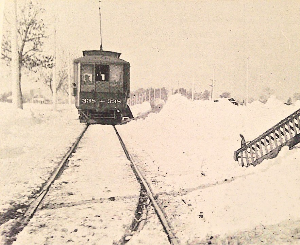
October 25, 1906 This photo was taken near Colfax & Ulster St, (not too far east of Quebec St), right after a major snow storm. The house to the left in the background is 1455 Quince St., (right next door to the new Quince Essential Coffee House). (Photo from: Denver's Street Railways Volume II - 1901-1950, compiled and written by Don Robertson and Rev. W. Morris Cafky, 2004).
Not Available
Not Available
Not Available
Not Available
Not Available
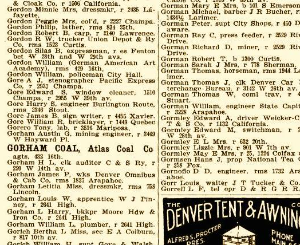
A clipping from the 1907 Ballenger & Richards 35th Annual Denver City Directory. Though the building permit record shows "William Gove" as the owner, the city directory says the name is William R. Gore. His occupation is listed as "bricklayer". When I asked a researcher at the library about the discrepancy in the names, he explained it was because the building permits record had been retyped from handwritten records. Chances are, someone misread the handwriting as "Gove" and not Gore. The 1907 city directory that I found also stated that Mr. Gore was living at 1449 Quebec St. Since only the carriage house existed at that time, Gore must have been residing in that structure. One of the researchers at the library did inform me that often times people would build a carriage house first and live in it until their main house was completed. Although small, the carriage house would have provided an open first floor living area and kitchen (with a small wood stove). The second (half-story)
Not Available
Not Available
Not Available
Not Available
Not Available
1908 Denver Building Permit Records: I finally found the building permit for the main house at 1449 Quebec Street, (Quebec House). This permit had also been requested by William Gore, on May 15th, 1908. The structure was to be 25' x 40' and built at a cost of $2,000 (approx. $50k in 2013 dollars). I haven't been able to find too much on the Gores after they finished Quebec House and sold it to the Burliens, in 1911. They built another house at 16th and Poplar (which still exists - also constructed of reddish-orange brick), then moved to San Francisco, where William registered for the WWI draft.

Indoors
Not Available
Not Available
Not Available
Dining Room
An old postcard featuring the dining room of the S&R Avondale bungalow. "The Craftsman-style Avondale was a bungalow of rare and generous proportions and finishes. The bedrooms for example are much larger than those usually seen during the 1920s. The front porch is oversized and opens into a living room/dining area that must have seemed palatial by middle-class standards. Combined with the built-ins and beamed ceilings, the 1400 sq. ft. space must have been compelling to many buyers." Photo and caption from: http://antiquehomestyle.com/plans/sears/1923sears/23sears-avondale.htm — at Montclair Neighborhood.
Outdoors
Not Available
Not Available
Not Available
Not Available
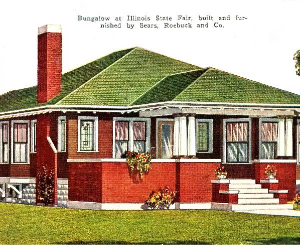
Sears & Roebuck Kit Home - The Avondale - First Introduced in 1911 In the early years of the twentieth century, bungalows were an affordable option for those upper middle class families who wanted to build a home of their own. The bungalow depicted in this postcard, called the Avondale, was one of the finest homes designed by the Sears & Roebuck. My attempts to locate the plans for Quebec House have been unsuccessful. Most likely, they were from a house plan book that has long since disappeared from history. There are many bungalows of this style throughout Denver, but often times, you'll only find them half as big as Quebec House. The closest I've been able to find (in dimensions and design) is the Avondale. Though this home certainly isn't a Sears & Roebuck, Gore's design shares many of the same characteristics, (similar woodwork, stained glass windows, rustic fireplace, room dimensions, number of rooms, and a strikingly similar floor plan).

Indoors
Not Available
Not Available
Not Available
Living Room
A living room sketch of the S&R Avondale's interior. I've been told that Quebec House may have looked quite similar to this when it was first built, back in 1908.
Not Available
Not Available
Not Available
Not Available
Not Available
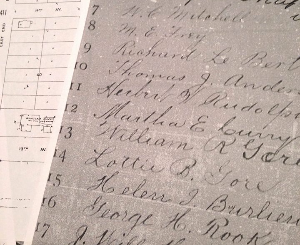
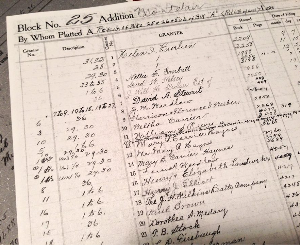
Eventually, I discovered the transfer of title/deed of the plots of land on the 1400 block of Quebec St. Not only was William Gore listed as an owner of 1449 Quebec, but so was his Wife, Lottie B. Gore. He owned half and she owned the "undeveloped" half. Was she living in the carriage house with him? When was the main house built? Following the chain of title, I noticed that in 1911, the property was sold to Helen Burlien, John Burlien's wife (from the 1930 census record I found).
Not Available
Not Available
Not Available
Not Available
Not Available
Not only did the grantor/grantee records show the sale of 1449 Quebec to the Burliens, it also showed that they owned both halves of 1445 Quebec Street (my neighbor to the south). You don't see too many small reddish-orange brick bungalows this far from downtown, (large clusters of such homes are typical near City Park, Platt Park, and Wash Park neighborhoods), so it's no surprise that the two homes were related.
Not Available
Not Available
Not Available
Not Available
Not Available
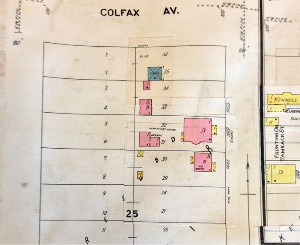
Sanborn Fire Insurance Map - Depicting the 1400 Block of Quebec Street, in the 1920s. I went to the Denver Public Library, and took a look through their collection of Sanborn Fire Insurance Maps. These were great resources for discovering what structures were present on my block during certain periods of time. The largest structure in this picture, in pink, is 1449 Quebec (my house). The smaller structure right below it is 1445 Quebec. Even my garage and the small house next door (to the north) are shown on this map. Though current property records state the house was built in 1905, the earlier edition of the Sanborn Maps, depicting the 1400 block of Quebec Street in 1905, clearly showed that nothing was there. This can only mean that the house was built before 1920, but not before 1905.
Outdoors
Not Available
Not Available
Not Available
Not Available
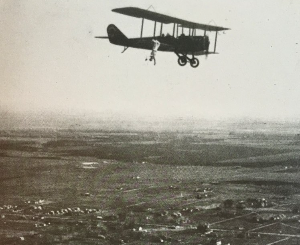
1920-1930s: Photograph of a stuntman hanging on to the wing of a biplane, as it soars over the Montclair and Park Hill neighborhoods. The street that cuts left to right (near the middle of the photo) is Colfax. The campus of the Colorado Women's College (now Johnson & Wales University), can be seen at the far left. It's blury, but Quebec House would be located just below the very center of this photograph. (Photo from: Wings Over the Rockies Air and Space Museum archives)
Not Available
Spring
Not Available
Not Available
Not Available
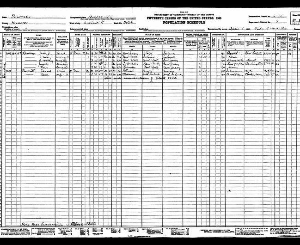
1930 Census Record: I found this 1930 census record online and it listed a man named John Burlien as the head of the household at 1449 Quebec Street. His family consisted of his wife Helen and three daughters: Dorothy, Janette, and Lois. His profession was in real estate and the estimated value of the home was $5,000 (or $66,000 in 2012 dollars). It made me wonder whether Lois Burlien and Lois McGovern were the same person. That's when I decided to check out the Western History section of the Denver Public Library in person. If you haven't been and you're interested in local history, I highly recommend checking it out.
Not Available
Not Available
Not Available
Not Available
Not Available
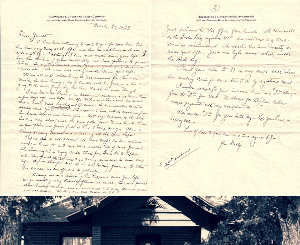
A letter written from John Burlien to his daughter, Janette, on March 27th, 1932. In this letter, John wrote that the weather had been unseasonably warm (much like this past March of 2017), but he also included the following: "Colfax Ave is all plowed up, and traffic has been detoured past our house to 14th Ave which makes lots of dust for us. The Tramway Co is laying double tracks from Birch St to Poplar. When they finish the city will begin paving so it will be some time before they are through, but as are looking forward to better car service, we can afford to be patient." This would have been around the time that the Poplar Street Loop Station was being completed, after streetcar service was discontinued to Aurora that year. An image of the streetcar station that was once at Colfax & Poplar can be seen in the next photograph.
Not Available
Not Available
Not Available
Not Available
Not Available
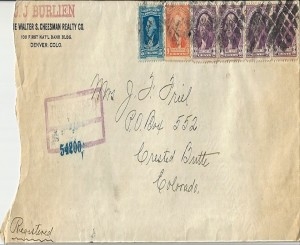
An envelope from a letter John Burlien sent his daughter, Janette, while she was living in Crested Butte, CO, in the 1930s. It shows that it came from his office downtown, in the old 1st National Bank building.

Not Available
Not Available
Not Available
Not Available
Not Available
After streetcar service was discontinued to Aurora, the end of the line was moved to Colfax & Poplar. This photo, taken in 1932, shows the construction of the brick streetcar station located at the Poplar Street Loop. The garage at Quebec House can be seen just to the right of the station in the background. (Photo from: Denver's Street Railways Volume II - 1901-1950, compiled and written by Don Robertson and Rev. W. Morris Cafky, 2004).
Not Available
Not Available
Not Available
Not Available
Not Available
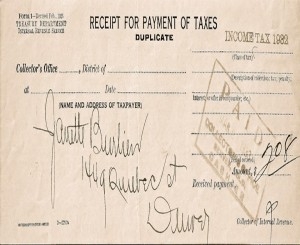
Back in the day, an agent of the municipal treasury department would actually go door to door, and collect property tax payments. This receipt is from the 1932 property tax payment at 1449 Quebec. It was paid for by John & Helen's daughter, Janette, for a whopping $2.08.
Not Available
Not Available
Not Available
Not Available
Not Available
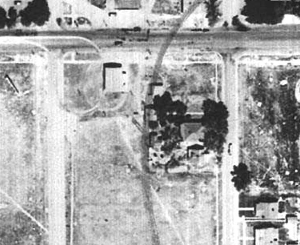
Arial photo of the 1400 block of Quebec Street, in 1933. You can see the Poplar Street Station at the upper left of the block (with it's circular streetcar track - looping back towards downtown). Slightly to the right, Quebec House and the Burlien-Dodge house can be seen, surrounded by trees. Quebec House and the Burlien-Dodge house are practically the only residential structures on the 1400 block of Quebec Street, in 1933. This image was found using denverflashback.com. The website has tons of arial photos of Denver from 1933.
Outdoors
Not Available
Not Available
Not Available
Not Available
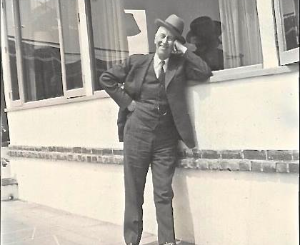
Photo of John Burlien (location in Denver unknown), taken in the 1930s or 40s. He was a very successful accountant and a great family man. His relatives recall him as being warm, caring, and a bit of a jokester. He was known to his daughters as "Daddy" and to his grandchildren as "Poppy".
Not Available
Not Available
Not Available
Not Available
Not Available
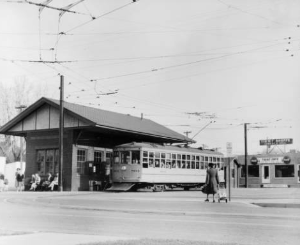
The Poplar St. Streetcar Station at Colfax and Poplar. Commercialization boomed along this stretch of Colfax after the construction of the Poplar Loop streetcar station. Conveniently located between the Denver Municipal Airport and Lowry Air Force Base, this area became an important commercial and travel center for the neighboring residents. Photo from the Denver Public Library Digital Archives
Outdoors
Not Available
Not Available
Front
Not Available
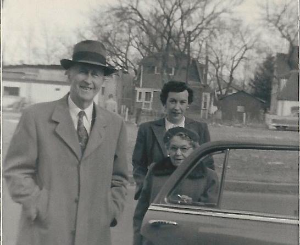
Photo of: John, Helen, & Lois Burlien Up until her mid-thirties, Lois was unmarried and continued to live at home with her aging mother and father. Census records show that she worked as a secretary of a bank for a period of time, as well as volunteered with the USO during WWII. This photo was taken of the three Burliens, in the driveway at 1449 Quebec Street.
Not Available
Not Available
Not Available
Not Available
Not Available
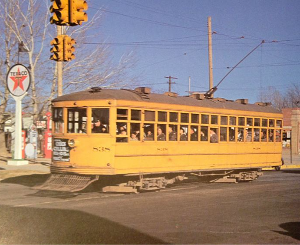
December 3rd, 1949 A photo of streetcar #838, which had just turned out of the Poplar Street Loop, westbound onto East Colfax Avenue. Unfortunately the shops in the background, including Loop Drugs, (between Poplar and Quebec on the north side of Colfax), were leveled years ago. The shops between Poplar and Quebec on the south side of Colfax still remain, although in rough shape. (Photo from: Denver's Street Railways Volume II - 1901-1950, compiled and written by Don Robertson and Rev. W. Morris Cafky, 2004).
Not Available
Not Available
Not Available
Not Available
Not Available
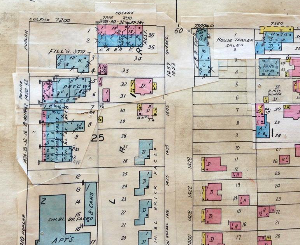
1950s edition of the Sanborn Fire Insurance Maps: In a more recent volume of the Sanborn Maps (approx 1950s), I found another map of the 1400 block of Quebec. You can still see 1445 & 1449 Quebec (near the middle of the map), but now several other buildings have been added. In the 30-40 years since the last map, there has been an explosion of growth on this stretch of Colfax, in Montclair. This was due to the construction of the Denver Municipal Airport (later Stapleton Airport) to the north and Lowry Air Force Base to the south.

Not Available
Not Available
Not Available
Not Available
Not Available
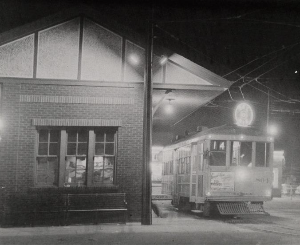
The shops at Colfax and Quebec (1950) This photograph shows the Denver Tramway streetcar #816 leaving the Poplar Street Loop Station. Once again, the chimney of the garage at Quebec House can be seen just to the right of the station in the background.
Not Available
Not Available
Not Available
Not Available
Not Available
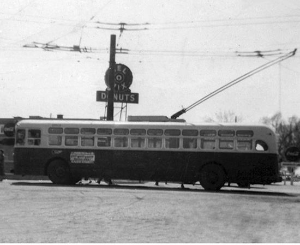
The Poplar Street Loop building, with buses on the left and streetcars on the right. This photo was taken on June 3rd, 1950, which was the last night of operation for route 14 streetcars. The Mel-O-Mix Donut sign can be seen shining brightly in the background. (Photo from: Denver's Street Railways Volume II - 1901-1950, compiled and written by Don Robertson and Rev. W. Morris Cafky, 2004).
Not Available
Not Available
Not Available
Not Available
Not Available
In 1950, the old streetcar trolleys were taken out of service and replaced with new, "modern" trolley coaches (electric buses). This photo shows a trolley coach pulling into the Poplar Street Station, just north of the Poplar Street Shops. This photo was taken after the streetcars were taken out of service in the 1950s. The Mel-O-Mix Donuts sign can be seen atop the shops along Poplar Street. Within 5 years after the streetcars were taken out of service, the overhead trolley infrastructure was removed and conventional buses completely took over. In May of 1971, the Denver Tramway Company sold it's entire assets and operations to the City and County of Denver. The new city and county operated transit service would eventually become known as the Regional Transportation District.
Not Available
Not Available
Not Available
Not Available
Not Available
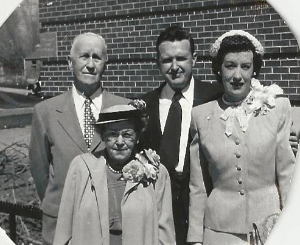
Photo of: John & Helen Burlien, and Garth & Lois McGovern On April 19th, 1952, Lois married Garth William McGovern. He converted to Catholicism for Lois, and his Catholic name became "Michael", (which is why Lois is referred to as "Mrs. Michael McGovern" on church newsletters from that time). Garth joined Lois, John, & Helen at 1449 Quebec, making it his home. Relatives describe garth as a "strange duck", to say the least. haha Lois, on the other hand, was gracious and infinitely kind.
Outdoors
Summer
Not Available
Back
Not Available
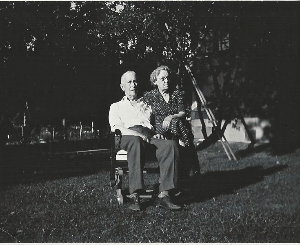
John & Helen Burlien, in the back yard at 1449 Quebec, taken in the 1950s. The windows of the original sleeping porch are barely visible behind the foliage.
Not Available
Not Available
Not Available
Not Available
Not Available
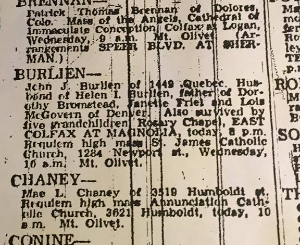
Obituary for John J. Burlien - March 1956 After his brother helped him get the job with the W.S. Cheesman Realty Company, John went on to work there for another 26 years, before retiring. He started out as a clerk, then bookkeeper and eventually a real estate agent. Af the time of his passing, John owned several commercial properties throughout the city (including the shop that most recently housed the Cheeky Monk, at Colfax and Pearl) and even held stock in Denver's German American Trust Company.
Not Available
Not Available
Not Available
Not Available
Not Available
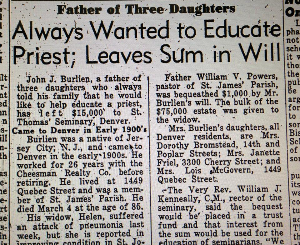
A clipping from the Denver Catholic Register, in March of 1956. The article announced a $15,000 donation made to a local Catholic seminary, as specified in John J. Burlien's will, (approx. $130,000 in 2014 dollars).
Not Available
Not Available
Not Available
Not Available
Not Available
After John and Helen passed away in the 1950s, Quebec House was passed down to their youngest daughter, Lois. Lois and her husband, Garth "Michael" McGovern, would go on to live in the house until they each passed away in the late 1980s. Lois and Michael McGovern never had any children, however, and the home was eventually passed down to a nephew, Janette's son, John Burlien Friel, (named after his maternal grandfather). The house would remain in a family trust until 1996, when it was sold to a non-family member. In total, the home had remained in the Burlien family for 85 years.
.jpg)
Outdoors
Not Available
Not Available
Not Available
Not Available
August 22nd, 1964 - Photo taken at the wedding of Janette Friel's son, Emmett. The three Burlien girls and their husbands (left to right): James & Janette Friel, Dorothy & Harold Bromstead, and Lois & Garth (Michael) McGovern.
Outdoors
Not Available
Not Available
Not Available
Not Available
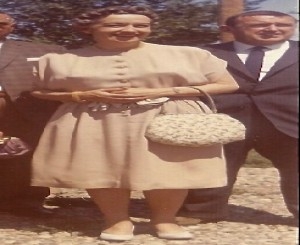
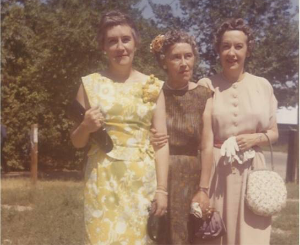
The Three Burlien Girls: Janette, Dorothy, & Lois When each of the girls got married, they all made Burlien their middle names.
Outdoors
Spring
Not Available
Front
Not Available
In the 1970s, Quebec House was featured on a historic walking tour of the Montclair neighborhood. "The house, a solid brick structure, featured leaded and stained glass windows, as well as an oval glass front door. Brick bays along with the front porch (repeating the flared hip roof) give this house an endearing symmetry, " (description from the walking tour mentioned in Tom Noel's book, Richthofen's Montclair).
Outdoors
Not Available
Not Available
Not Available
Not Available
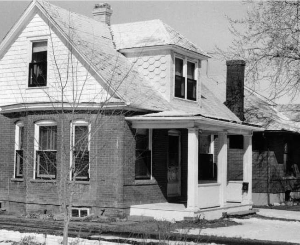
1445 Quebec, as it would have appeared in its heyday. While researching the history of my house, I wound up discovering more info about the house next door, at 1445 Quebec Street. I found a building permit record that had been requested by the Bowen & Dinsmore Company, on 12/26/1907, for John J. Burlien, (last name pronounced "bur-lin"). It was to be 22' x 24', and built at a cost of $1,000 (about $25k in 2013 dollars). The permit was filed the day after Christmas, so perhaps it was a Christmas present from John to his family? The Denver City Directory at that time showed the Burliens as living near south Lincoln Street (Wash Park West neighborhood).
Outdoors
Summer
Not Available
Front
Not Available
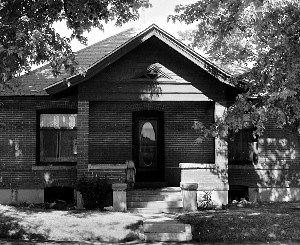
This photo was taken in 1976, by local historian, Thomas Noel. Not long after we moved into the house, I discovered this photograph in the Denver Public Library archives. Nate and I were amazed. The home in the photograph had such a strong presence. I was sad to realize that the original windows and doors were gone. The picket-designed leaded glass windows and oval window front door were incredible. I had to find out more about this house... So, I started researching the history of the house and the Montclair neighborhood. (Photo is from the Denver Public Library digital photo archives)
Outdoors
Not Available
Not Available
Not Available
Not Available
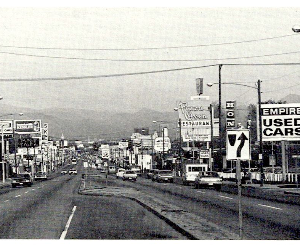
"During the boom years of the 1940s and 1950s along the business barometer of East Colfax, where the Baron von Richthofen once planted his Elms, change was most evident. The elm trees were cut down and the concrete corridor was fattened. Many of the substantial old homes that once made East Colfax a fashionable residential district had undergone ingenious transformation, reappearing as shops selling everything from tropical fish to false teeth, from books to caskets. Above all, Colfax became an ode to the automobile, a gasoline alley of service stations and car lots. Such signs of "progress" on East Colfax and the general pattern of urban blight and suburban flight greatly troubled Montclair in the 1960s. During the 1960s the crime, welfare, unemployment, and overcrowding rates all rose, (Noel, 1976)."
Outdoors
Not Available
Not Available
Not Available
Not Available
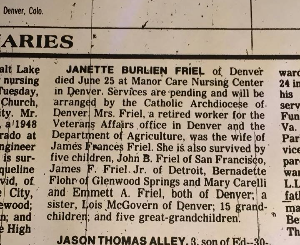
The obituary for Janette Burlien Friel - 1988
Not Available
Not Available
Not Available
Not Available
Not Available
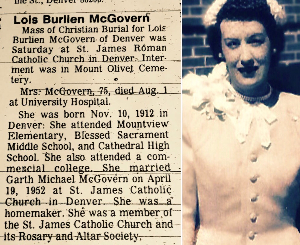
Obituary for Lois Burlien McGovern - August 1988 It's not mentioned here, but Lois had been a secretary at a bank for a while, and even worked with the USO during World War II. My elderly neighbors remember her as a very nice woman, who often held church gatherings (lunches/Rosary Society Meetings/etc) at Quebec House. At some point, Lois was diagnosed with multiple sclerosis, which eventually led to her passing in 1988.
Outdoors
Winter
House Fire
Front
Not Available
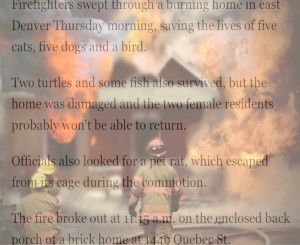
On December 18th, 2003, a fire was accidentally started by one of the residents at 1449 Quebec Street (Quebec House). The fire started on the sleeping porch, directly behind the kitchen. It quickly spread throughout the porch and onto the roof. It was an enormous fire, which took 34 firemen to put out. By the time the flames were put out, it was discovered that half of the rear exterior wall had collapsed. Though two female residents survived the fire, along with many of their pets, several other animals died. In 2004, the owners began a full renovation of what remained of the nearly 100-year-old structure. By 2009, however, the growing renovation costs became too great and the home was eventually foreclosed upon. Quebec House would sit empty until it was purchased later that year by a real estate development company.
Outdoors
Summer
Not Available
Front
Not Available
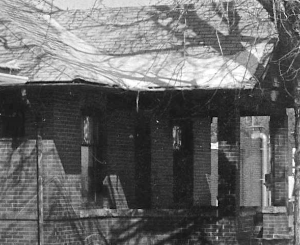
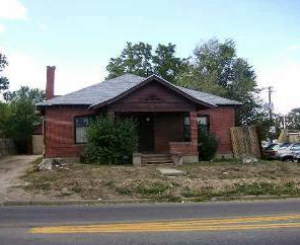
Quebec House as it appeared in 2009, after it was lost in foreclosure. The entire roof had been professionally rebuilt, though it lost its flared style. Structural beams were added in the basement, to support the weight of the house and new roof. Many of the original elements were torn out, however, including all the original doors, windows, built-ins, and oak woodwork. Even the four large maple trees, that once shaded the front of the house, were chopped down. The rundown appearance caused many in the neighborhood to refer to it as the "haunted house".
Indoors
Summer
Not Available
Not Available
Living Room
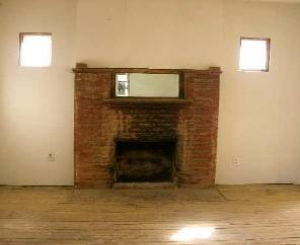
Parlor / Living Room - 2009 Once a Montclair showpiece and great example of the early American bungalow, Quebec House suffered severe neglect, having been stripped of it's oak woodwork, as well as its leaded crystal and glass windows. Originally, there had been stained glass windows, in an intricate rose and leaf pattern, on each side of the fireplace.
Indoors
Not Available
Not Available
Not Available
Kitchen
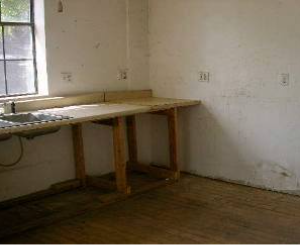
Perhaps most appalling of all the transgressions against the once beautiful home was the condition of the kitchen when Quebec House went into foreclosure in 2009. In December of 2003, a fire had started on the sleeping porch, directly behind the kitchen. The enormous fire, which took 34 firemen to put out, caused half of the rear exterior wall to collapse. The home survived the blaze, however, but the original kitchen had been completely destroyed.
Outdoors
Summer
Not Available
Back
Not Available
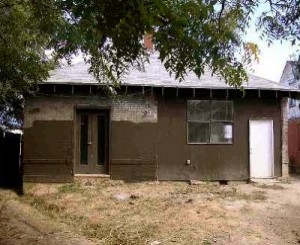
Back side of Quebec House - 2009 This photograph shows the poor patchwork job completed on the right half of the rear exterior wall (after the fire in 2003). The entire roof had to be rebuilt, as well. The sleeping porch, which once ran the length of the rear exterior wall of the home, was never rebuilt. When the real estate company took ownership of the home, they crudely sided over the rear exterior wall, rather than replace the brick.
Outdoors
Summer
Not Available
Garage
Not Available
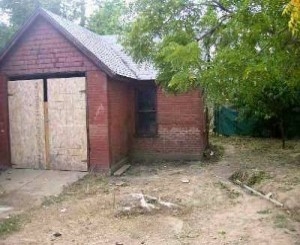
The carriage house as it appeared in 2009. In late 2009, another series of renovations began by a professional real estate developer. Their "improvements" to the property eliminated the remaining historic features of the home, which included the remaining oak woodwork, as well as the leaded and stained glass windows, (which had survived 2003 fire). In the face of apparently insurmountable financial obstacles, however, the property was lost again to foreclosure in the Fall of 2011. Quebec House sat empty and unfinished once again. That is, until February of 2012.
Outdoors
Not Available
Not Available
Front
Not Available
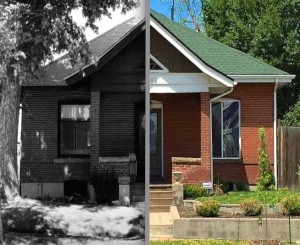
Past & Present: My partner, Nate, and I purchased the home in February 2012. We immediately began trying to restore all the historic charm that this home had lost, (adding woodwork and built-ins throughout the home). Fortunately the real estate developers had taken care of the major structural improvements, as well as replacing all of the plumbing, electrical, and heating, (i.e., the really expensive stuff). Eventually, however, we'd like to replace the front facing windows (with leaded glass windows similar to the originals), as well as the stained glass windows that used to be in the parlor.
Outdoors
Winter
Not Available
Front
Not Available
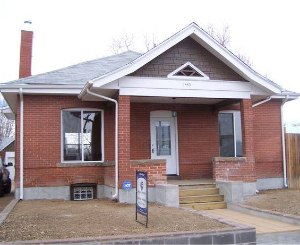
Quebec House - February 24th, 2012 This is what the home looked like on the day we purchased the home. Though the real estate company had done a great job replacing all the expensive things (electrical, plumbing, heating, and new windows), the home was still lacking any of its original bungalow charm (and landscaping).
Outdoors
Winter
Not Available
Garage
Not Available
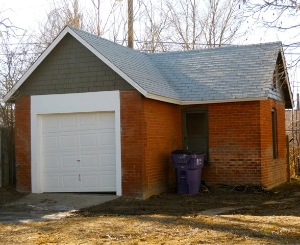
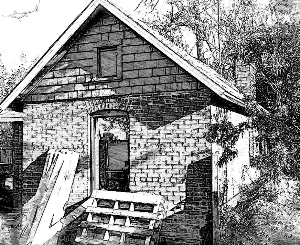
Carriage House - February 2012 This is what the carriage house looked like when we first purchased the home. I'd eventually discover that it was the first structure to be built on the property, (back in 1906). It has a second level and an old chimney off the back, which used to connect to an old wood stove inside.
Not Available
Not Available
Not Available
Not Available
Not Available
So, after reviewing the building permit records, I learned that the first structure to be built at 1449 Quebec, was actually the garage. At that time, however, it would have been a carriage house. In 1906, cars were only owned by the wealthy. The structure was so far away from downtown Denver, that "Gove" would have had to either use a horse and buggy to travel back and forth, or use the nearby streetcar line, on Colfax.
Outdoors
Summer
Not Available
Not Available
Not Available
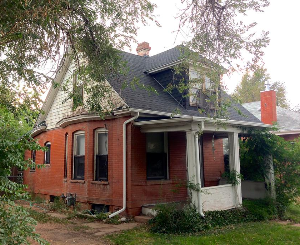
1445 Quebec - Summer 2013 While researching the history of my house, I wound up discovering more info about the house next door, at 1445 Quebec Street. John & Helen Burlien built this home in 1907, while waiting for their "forever home" to be built right next door, at 1449 Quebec Street. They hired William Gore, a master bricklayer, to build the home, including a carriage house at the back of the property. Though the Burliens moved into Quebec House in September of 1911, records indicate that they continued to own 1445 Quebec for quite some time, (perhaps renting it out - as other names are listed at that address in subsequent city directories).
Outdoors
Fall/Autumn
Not Available
Not Available
Not Available
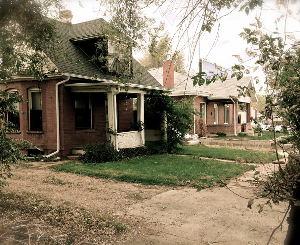
On the left is 1445 Quebec (Burlien-Dodge House), and on the right is 1449 Quebec (Quebec House). In July of 1936, William and Mary Dodge purchased 1445 Quebec. William Dodge worked as a salesman for a successful wallpaper business in downtown Denver. Mary, a feisty Scottish immigrant, was a homemaker. The Dodges, along with their beloved deaf dog, (known throughout the neighborhood) would go on to spend the rest of their lives in that home. On one occasion, the Dodges had locked themselves out and needed the grandson of John Burlien, Emmett Friel, to climb in the basement and unlock the front door from the inside.
Outdoors
Summer
Not Available
Front
Not Available
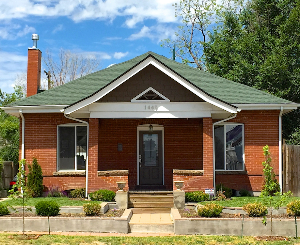
Quebec House as it appears today: During my initial research into the history of my home, (in early 2012), I discovered that the land the house sits on had originally been owned by Baron Walter Von Richthofen. Then, my elderly neighbors informed me that the house was originally built for one of the Baron's workers. I thought it would be interesting to try validate that claim, but the Baron passed away in 1898 and the house wasn't built until the early 1900s. You do the math... The public records of the City and County of Denver list the actual construction year as 1905. The farthest back that the chain of title went, however, was only the 1980s/1990s. It listed Lois B. McGovern as the owner.

